
The Moment AI-Powered Defect Detection Changed Everything
In 2023, less than half of high-speed printing facilities worldwide had adopted automated print inspection systems. By 2025, industry surveys show that figure has crossed 60% — driven almost entirely by the arrival of affordable, AI-native systems that no longer require specialist machine vision engineers to operate.
The shift matters because traditional rule-based print quality inspection systems were locked in a permanent trade-off: tighten the detection threshold, and you'd drown in false alarms; loosen it, and real defects slipped through. AI changes the equation. Deep learning models trained on thousands of real-world defect images can distinguish a genuine dot-missing event from a substrate texture variation — something no rule-based algorithm could reliably do.
Market Intelligence · 2025
AI-driven inspection systems now demonstrate accuracy improvements of over 30% compared to traditional machine vision methods, while simultaneously reducing false rejection rates — the two metrics that previously forced manufacturers to choose one over the other.
See the SICHANGO OVERSEER 100 in Action
Product Demo · Live Press Line
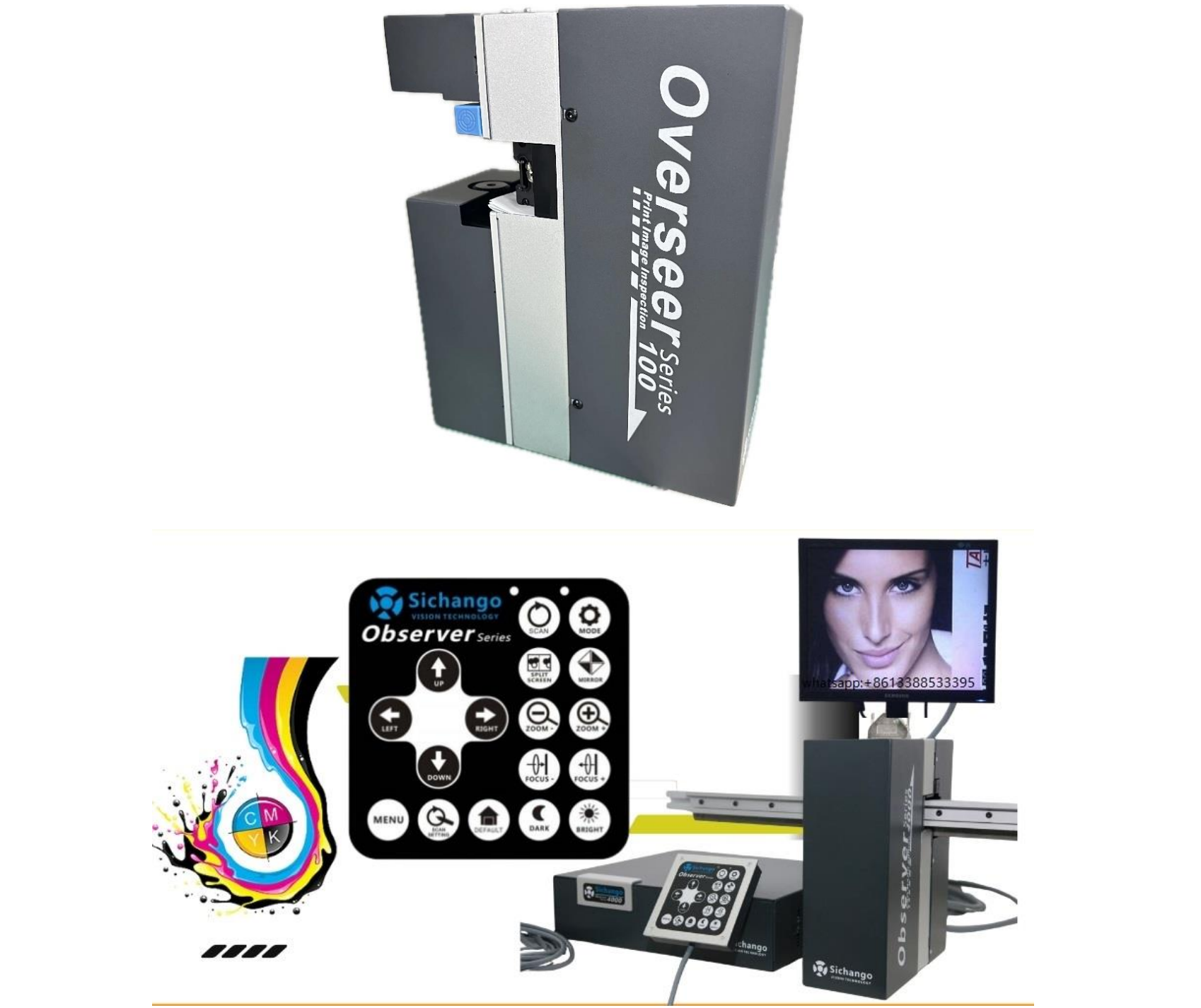
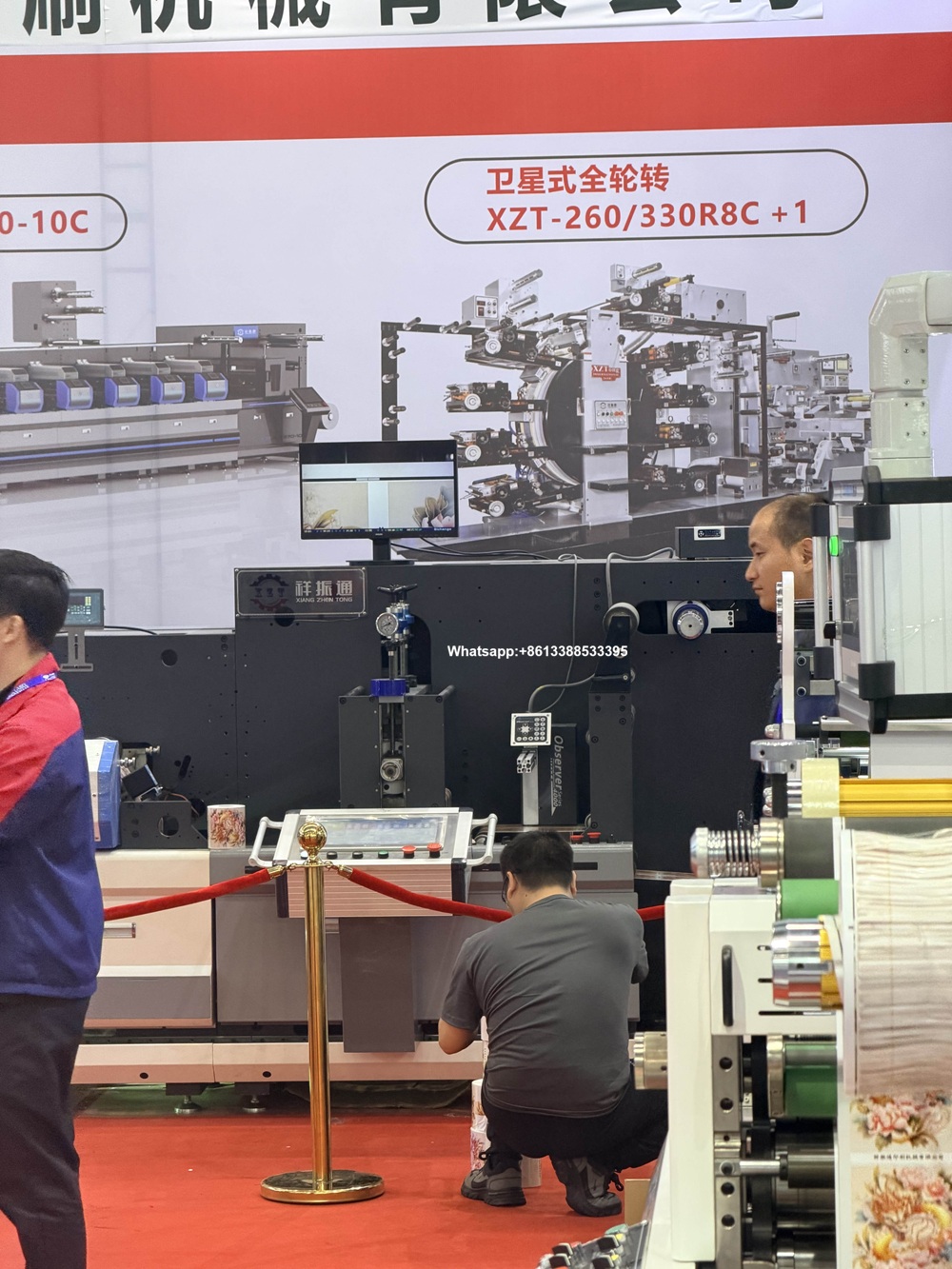
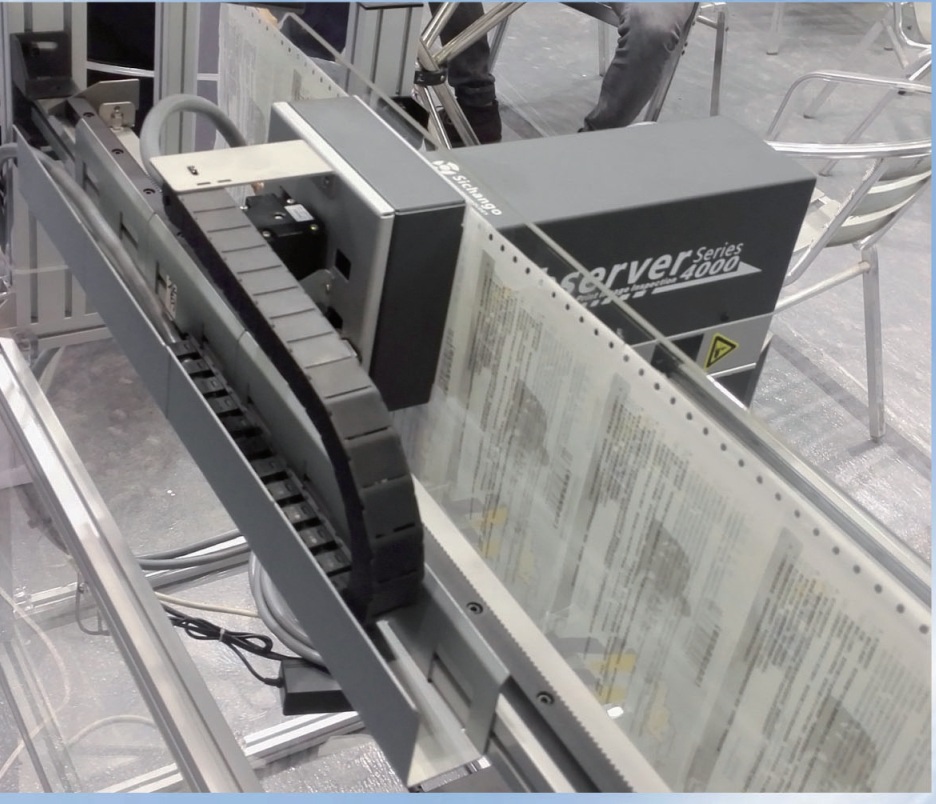
SICHANGO OVERSEER 100 — Real-Time AI Print Defect Detection at 600 m/min
Watch: 4K line-scan camera, AI defect classification, and Industry 4.0 dashboard — all running simultaneously at full press speed.
Inside the SICHANGO OVERSEER 100: A Technical Deep Dive
The market is flooded with "AI print inspection" claims. What's actually different about the OVERSEER 100's approach?
Most systems bolt AI onto an existing camera setup as an afterthought — they use AI to reclassify defects after a rules engine has already flagged them. We built the OVERSEER 100 the other way around: the AI model is the primary detection engine, and the 4K line-scan camera is optimized to feed it the highest-quality image data possible. Our LED strobe system is synchronized to the camera's line rate at the nanosecond level, which eliminates motion blur even at 600 m/min — because a blurry image is garbage input no matter how good your AI model is. The result is that we're detecting defects at the image quality level, not compensating for poor optics with smarter software.
How does the OVERSEER 100 handle the challenge of variable substrates — metallized films, transparent materials, textured papers?
This is where AI earns its place over classical machine vision. Metallized and textured substrates create specular reflection patterns that change with substrate batch, humidity, and press speed — patterns a rules engine would either flag as defects or ignore entirely. Our model is trained on material-specific datasets, and operators can fine-tune sensitivity thresholds per substrate type via the interface. More importantly, the model continuously updates its baseline as it processes real production data — so a substrate that ran slightly different on Tuesday's shift is already accounted for by Wednesday's job.
Tell us about Industry 4.0 integration — what does that actually mean in a real print shop?
For most of our customers, "Industry 4.0 integration" previously meant exporting a PDF report at the end of a shift. The OVERSEER 100 connects directly to MIS and ERP systems via API, meaning quality data is live — visible on the production floor dashboard, in the plant manager's office, and accessible remotely. When a defect crosses a threshold, the system can automatically create a non-conformance record in your quality management software. Waste per roll is calculated in real time. OEE metrics update per job. For pharmaceutical customers, batch traceability reports are generated automatically in a format compatible with FDA 21 CFR audit requirements.
Deep Learning Defect Engine
CNN-based model trained on 50,000+ real defect images. Learns new variants with 60–70% fewer samples than traditional methods.
4K Line-Scan Camera
Nano-synchronized LED strobe eliminates motion blur at 600 m/min. Configurable from 300 mm to 4,500 mm web width.
Industry 4.0 / MES Integration
Live API connection to MIS, ERP, and QMS platforms. OEE dashboards, defect heat maps, and automated NCR creation.
100% Barcode & 2D Code Verification
Inline GS1 DataMatrix and QR code reading. FDA DSCSA track-and-trace compliant for pharmaceutical packaging.
Automated Colorimetry
CMYK density and ΔE color deviation measured per print unit against PDF-approved standards at full press speed.
Sub-Day Installation
Modular plug-and-play design. 95% of customers are fully operational within one working day — no automation engineers needed.
What Types of Print Defects Does the OVERSEER 100 Detect?
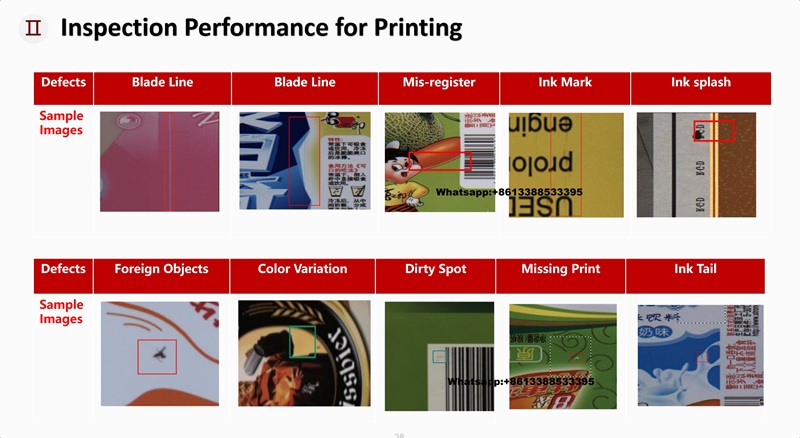
Unlike older inspection systems that were configured around a fixed defect library, the OVERSEER 100's AI engine treats every deviation from the PDF master as a candidate defect — classifying it by type, severity, and production context in real time.
Dot missing / void
HIGH IMPACT
Color misregistration
HIGH IMPACT
Streaks & banding
HIGH IMPACT
Barcode / QR failure
CRITICAL
Color deviation (ΔE)
MEDIUM IMPACT
Ink smearing
MEDIUM IMPACT
Pinholes / scratches
MEDIUM IMPACT
OCR text errors
HIGH IMPACT
The ROI Case for Automated Machine Vision Inspection
One of the most common questions we hear from production managers: "What does a print inspection system actually cost me — and what does it save?" The math is more compelling than most buyers expect.
Typical Annual Savings — Mid-Size Label Printer (5 presses, 3-shift operation)
Waste reduction (defective rolls caught early)
$85,000–$140,000
Reprint and reproof elimination
$30,000–$60,000
Customer complaint & recall prevention
$50,000–$200,000+
Reduced QC labor (inspection headcount)
$40,000–$80,000
Press downtime reduction (early defect alerts)
$20,000–$45,000
Estimated total annual saving
$225K–$525K
Engineer's Note
"For pharmaceutical packaging customers — where a single mislabeling event can trigger a market recall costing millions — the ROI calculation looks completely different. The automated defect detection system isn't a cost center. It's product liability insurance."
Industry Coverage: Where the OVERSEER 100 Is Deployed
Label printing (logistics, cosmetics, wine)
Flexible packaging (food & beverage)
Pharmaceutical serialization lines
Tobacco outer packaging
Security & banknote printing
Flexographic web presses
Gravure packaging lines
Digital & hybrid print lines
Folding carton converters
Medical device packaging
2025 Industry Context: What's Driving the AI Inspection Surge
The print quality inspection system market doesn't operate in isolation. Here's the external pressure reshaping buying decisions in 2025:
May 2025
FDA DSCSA compliance mandatory for pharmaceutical manufacturers and repackagers — requiring 100% inline barcode verification on all pharmaceutical packaging lines.
Q1 2025
Global print inspection market valued at $265M, on track for 5.3% CAGR to 2033. AI-native systems now account for 38% of all new installations, up from 12% in 2021.
2025 Tariff landscape
US tariff shifts on European and Asian hardware are prompting print buyers to reassess total cost of ownership. Chinese-manufactured AI inspection systems are seeing 40%+ inquiry growth from North American converters.
Industry 4.0 acceleration
Over 60% of high-volume printing facilities have now implemented 100% inline inspection — up from under 40% in 2022. The baseline expectation has shifted: sampled inspection is no longer considered acceptable for regulated industries.
SICHANGO OVERSEER 100 vs. European Systems: An Honest Comparison
The most common pre-purchase research query we encounter is some form of "how does SICHANGO compare to AVT / BST / Erhardt+Leimer?" Here's a direct answer — based on what our customers report after switching.
| Evaluation Criterion | SICHANGO OVERSEER 100 | AVT / BST / Erhardt+Leimer |
|---|---|---|
| Max inspection speed | 600 m/min matched | 500–600 m/min (model-dependent) |
| AI defect classification | Standard — included in base | Often optional / premium tier |
| MIS / ERP live integration | API included — no add-on cost | Premium feature or third-party cost |
| Installation time | < 1 working day | 2–5 days + engineer travel |
| Substrate adaptability | High — AI model retraining | Moderate — rules reconfiguration |
| Factory price | Significantly lower — no distributor | High — distributor network markup |
| Pharmaceutical GMP support | FDA 21 CFR, EU GMP audit trails | Available (varies by model) |
| Customization flexibility | High — modular hardware | Limited by product catalog |
| After-sales support | Remote + fast parts dispatch | Varies by region and distributor |
Buyer's note: European brand recognition is real — and for some buyers, the audit trail of a globally recognized name has internal political value. What's changed in 2025 is that the technical gap has closed. The commercial and flexibility gap now favors SICHANGO meaningfully.
Frequently Asked Questions
What is an AI visual inspection system for web printing?
An AI visual inspection system for web printing uses machine vision cameras and deep learning to automatically detect print defects — dot-missing, color misregistration, streaks, barcode errors — at full press speed without human intervention. Systems like the SICHANGO OVERSEER 100 achieve 99%+ accuracy at up to 600 m/min.
How does automated print defect detection work?
A 4K line-scan camera captures every frame of the printed web in real time. The AI engine compares each frame against the approved PDF master, classifying any deviation by type and severity. Defects above the configured threshold trigger an alarm, press mark, or press stop — with location, timestamp, and image saved for QC records.
What is the difference between inline and offline print inspection?
Inline inspection (like the OVERSEER 100) is mounted on the press and inspects 100% of output at full speed — catching defects before significant waste accumulates. Offline inspection happens after printing on a separate rewinding station, meaning defects are only discovered after an entire roll is already printed and potentially shipped.
Is the SICHANGO OVERSEER 100 Industry 4.0 compatible?
Yes. The OVERSEER 100 includes live API connectivity to MIS, ERP, and QMS platforms, cloud-based quality reporting, OEE dashboards, and per-job defect analytics. Inspection data feeds directly into your smart factory ecosystem — no manual data export required.
What ROI can I expect from an AI print inspection system?
Customers typically achieve ROI within 6–18 months. Key savings: waste reduction from catching defective rolls early, elimination of reprints, lower QC labor costs, and prevention of costly product recalls — particularly significant for pharmaceutical and food packaging operations.
Does the OVERSEER 100 support pharmaceutical GMP and FDA compliance?
Yes. The OVERSEER 100 supports pharmaceutical packaging lines with 100% barcode and GS1 DataMatrix 2D code verification, batch traceability reports, and audit trail logging compatible with FDA 21 CFR and EU GMP documentation requirements — including DSCSA track-and-trace mandates effective 2025.
How does SICHANGO compare to AVT or BST eltromat?
SICHANGO matches European systems in inspection speed and AI accuracy, while offering significantly lower factory pricing (no distributor markups), faster installation (<1 day vs 2–5 days), built-in MIS integration as a standard feature, and greater hardware customization flexibility.
What print defects does the OVERSEER 100 detect?
Dot-missing, smearing, color misregistration, streaks, pinholes, scratches, missing or unreadable barcodes/QR codes, OCR text errors, color density deviation (ΔE), and any structural deviation from the approved PDF master file — all in real time at up to 600 m/min.
Ready to Upgrade to AI-Powered Print Inspection?
Speak directly with SICHANGO's engineering team. Factory pricing, full technical specs, and a free consultation — no distributors, no markup.
 English
 Español
 Русский